How do you turn sales and client conversations into content?
Every week, a commercial team has conversations worth publishing. Record them, feed them into one marketing brain, and let sales, search and website data steer what gets written.


Every week, a commercial team has some of the best conversations in the company. A prospect explains why a plan stalled. A client asks a question nobody has answered well online. Two colleagues argue about a shift in the market and, halfway through, one of them says something sharper than anything on the website. Then the call ends, the insight stays in someone’s head, and next week the marketing team opens a blank page and asks what to write about.
Short answer: record your conversations (with consent), collect the transcripts in one place every day, and review them weekly for what is worth publishing. The result is content that is relevant because it comes from real questions, unique because nobody else had those conversations, and well suited to AI search because it contains the specific, experience-based answers assistants look for. Connect the same system to your analytics and search data, and it also tells you what to change on your website.
Why conversations beat brainstorms
Most content calendars start from a keyword list or a brainstorm. Both have a place, but they describe what the market already writes about. A conversation tells you what your market is actually struggling with this week, in their words.
Three things happen when content starts from conversations:
- It is relevant. The topic was a real question, asked by a real buyer or client, not a guess about what might interest them.
- It is unique. A competitor can copy your keyword list. They cannot copy a conversation they were not part of. This matters more as AI assistants reward content that adds something new instead of repeating what already exists.
- It is consistent with what sales says. Marketing stops drifting away from the language buyers use, because that language is the raw material.
The workflow: one marketing brain
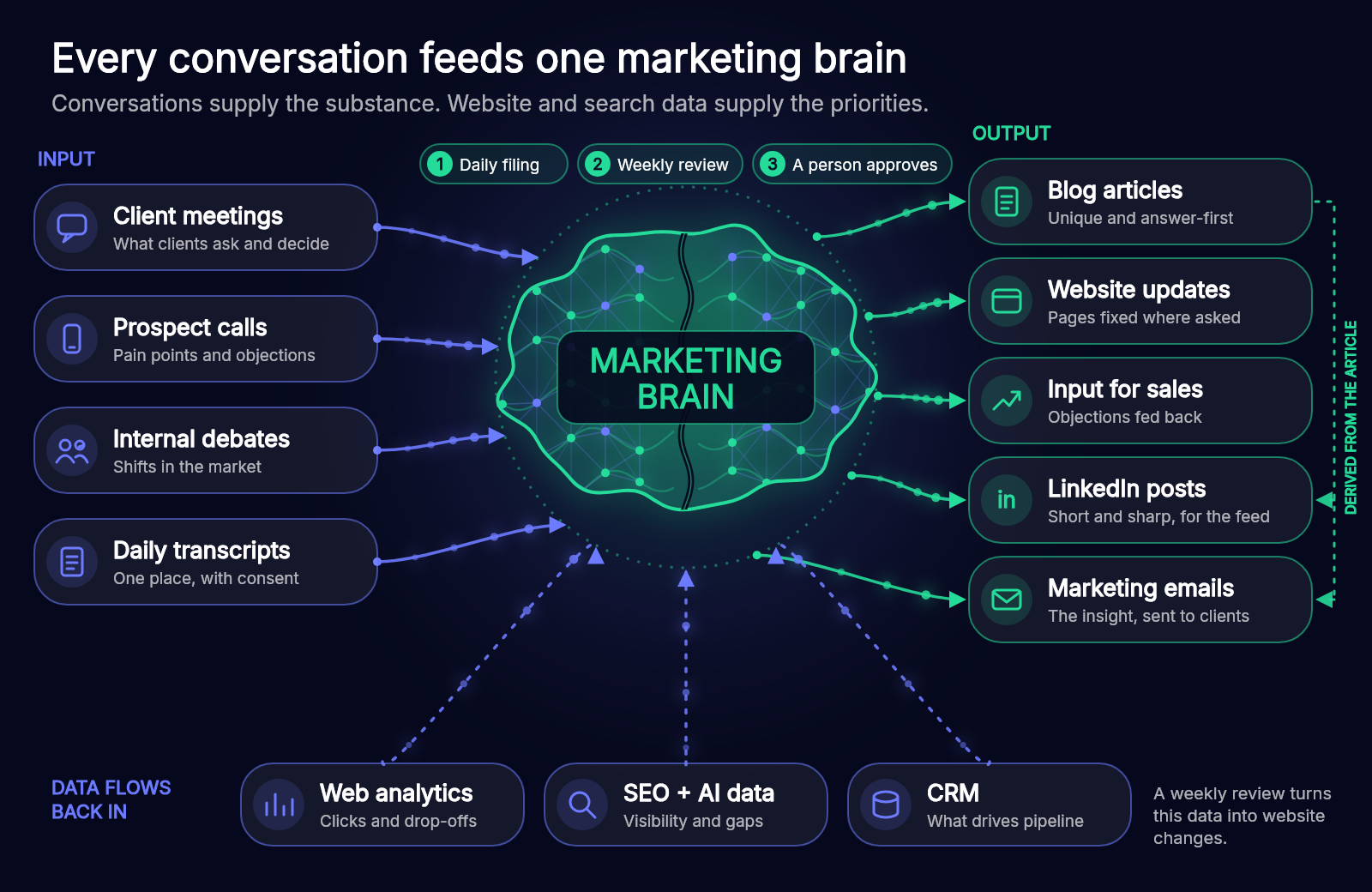
We record our meetings: client calls, prospect calls and internal discussions, including the debates about shifts in the commercial landscape. Everyone in the meeting knows it is recorded. Every day, the transcripts are pulled into our marketing brain, a workspace where all commercial context lives and where the marketing work is done. It is the same workspace we use for other commercial tasks, which is exactly the point: one place that knows what was said, what was decided and what is still open.
Each day, that brain files the conversations and extracts the follow-up actions. At the end of every week, it goes through the week’s conversations and asks a simple question: what did we say or hear that would be useful to someone else? The shortlist comes with a suggested angle for each idea. A person then decides what is worth writing.
Nothing is published automatically. Drafts go to a separate branch of the website, a person reads them, and only then do they go live. The system proposes and drafts; people approve.
What comes out of it
One conversation can be used more than once. The blog article is usually the anchor, and the rest is reuse:
- Blog articles on the website, written in the format AI assistants and search engines can quote: a direct short answer, clear sections, and a FAQ.
- Website updates. If prospects keep asking the same thing, the page that should answer it gets improved.
- Input for sales. The questions and objections that came up are fed back to the team that is having the next conversation.
- LinkedIn posts and marketing emails, derived from the same article and the same angle, so the message stays consistent across channels.
Because the source is a real conversation, none of this needs invented examples. The skill is generalising: removing names, figures and anything that belongs to a client, and keeping the insight.
The loop: data flows back in
The first loop runs from conversations to content. The second runs from your channels back into the brain. We connect the system to the tools that show what actually happens after publishing:
- Web analytics and session recordings show where visitors click, scroll and drop out. Every week, the brain runs a conversion review of the website and proposes concrete changes.
- SEO and AI visibility data shows which topics already earn visibility, where competitors are cited instead of you, and which questions have volume.
- The CRM shows which content and which pages are linked to conversations that become pipeline.
That data goes back in as context. The next weekly review is therefore not only “what was interesting” but also “what does the data say we are missing”. Conversations supply the substance, data supplies the priorities.
What it takes to get started
You do not need the full system on day one. The pattern is simple enough to start with a small version:
- Record and tell people. Agree on which meetings are recorded, inform every participant, and check that you have a legal basis for processing the recordings. Keep internal and external conversations clearly separated.
- Put everything in one place. One folder or workspace where transcripts land daily, with a consistent structure per type of conversation.
- Review weekly, not daily. A weekly rhythm is enough to spot patterns and avoids writing about one-off remarks.
- Set rules for what must never be published. Client names, figures, personal topics and anything confidential stay out. Decide this once, and write it down.
- Keep a human as the final editor. Automation finds and drafts. A person owns what goes out under the company’s name.
- Add data later. Start with the conversations. Connect analytics, search and CRM data once the weekly rhythm holds.
Where this gets bigger: sales teams that record everything
We started with our own meetings. The bigger opportunity is in companies where sales talks to prospects every day. Every discovery call contains the pain points, the objections, the comparisons buyers make and the words they use to describe their problem. Today, most of that stays inside the CRM notes of one rep, if it is written down at all.
Imagine a sales team where all calls are recorded and reviewed for patterns. Marketing would know which pain points come up most, which objections slow deals down, and which questions buyers ask before they ever fill in a form. Content, campaigns and website messaging could be built on that evidence instead of assumptions. Sales would get better material, and marketing would stop guessing. That is the real prize: not more content, but a shared view of the customer that both teams build on.
Frequently asked questions
Is it legal to record sales and client calls? It depends on the country and on how you do it, but the common baseline is to inform every participant before recording and to have a valid legal basis for processing the recording. In the EU this falls under data protection rules, so involve your legal or privacy contact before you start, and keep recordings and transcripts in a controlled place.
Won’t clients feel uncomfortable being recorded? Most people accept it when you explain why: to capture follow-up actions accurately and to make sure their questions are answered well. Be clear that nothing client-specific is published, and let anyone say no. The content that comes out uses the insight, never the client.
Does AI-written content hurt search and AI visibility? Generic content written from a prompt adds nothing new and is unlikely to be cited. Content that starts from real experience, is reviewed by a person and answers a specific question is a different thing. The conversation provides the original insight, and the AI helps structure and draft it.
How much of this can be automated? Collecting transcripts, extracting actions, suggesting angles, drafting articles and reuse for other channels can all be automated to a large degree. Deciding what is worth publishing, checking facts and approving the final text should stay with a person.
Do we need all the data tools connected to start? No. Start with the conversations and a weekly review. Analytics, search and CRM data make the priorities sharper, but the core value already comes from the transcripts.
Can this work in a B2C company as well? Yes. Anywhere that customers or prospects talk to your team, by phone, in a showroom, in a chat or on a call, there is material. The channel differs, but the principle is the same: capture the real questions and publish the answers.