How building materials manufacturers can create demand when the merchant owns the shelf
Building materials manufacturers sell through merchants, but the contractor decides. How to create demand with the people who specify and install your product, without bypassing the merchant.

Many building materials manufacturers have a strong product, enough capacity and a long relationship with the merchants who stock it. Yet growth stalls, especially for new products. The product is on the shelf, but the contractor who installs it does not ask for it.
This is not a failure of the supply chain. It is a gap in who creates demand. This article explains the gap and how a manufacturer can close it without replacing the channel that already works.
Short answer: A manufacturer that sells through merchants can create demand itself by reaching the contractors, installers and specifiers who decide, and handing qualified leads to the merchant for delivery and the transaction, while storing and nurturing those leads in its own database. The merchant keeps stock, logistics and invoicing. What changes is who builds the demand and who owns the relationship with the user.
The chain works, the demand is missing
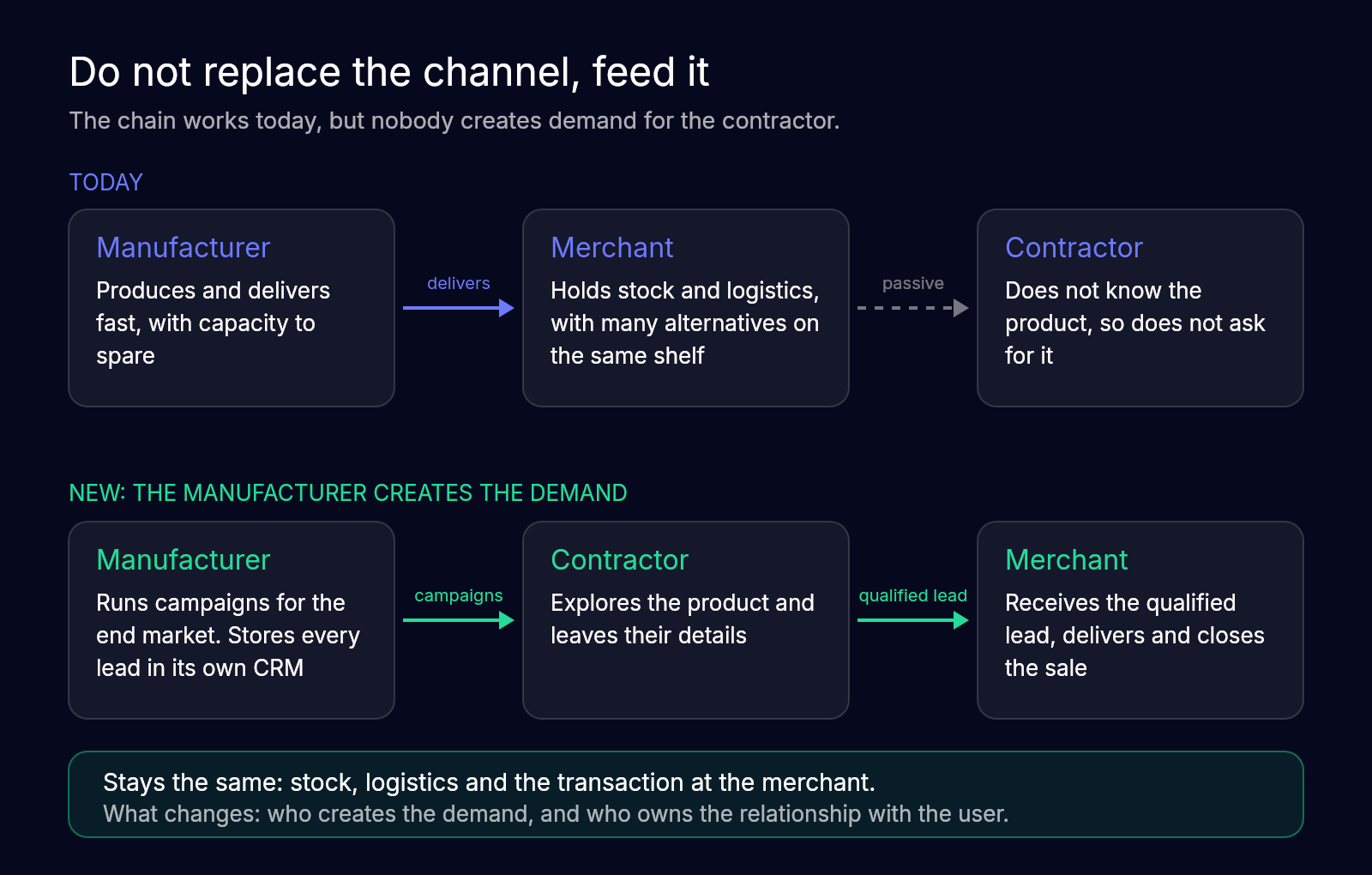
A typical chain looks like this. The manufacturer produces, delivers fast and often has capacity to spare. The merchant holds stock and logistics, and shelves many alternatives for the same job. The contractor, the roofer or the installer buys what they know and what they are asked for.
The merchant sells what the contractor requests, and the contractor asks for what they already know. A new product, or a better alternative to an established one, is therefore easy to stock and hard to sell. The merchant has little reason to promote one product over many others, and a limited ability to explain it. Nobody in the chain is explicitly responsible for creating demand for it.
Most manufacturers recognise this. Few have a structural answer. Trade shows and workshops reach a small part of the market, sales reps cannot visit every contractor, and the merchant’s own promotion is shared with every brand on the shelf.
Keep the merchant, change who creates demand
The option is not to bypass the merchant. Merchants carry stock, logistics and credit risk that few manufacturers want to take over. A manufacturer that tries to cut them out takes on cost and conflict for no gain.
The option is to add a layer on top of the existing channel. The manufacturer runs campaigns aimed at the end market, contractors and installers explore the product and leave their details, and the qualified lead is passed to the merchant, who delivers and closes the sale. The channel stays as it is. It is fed with demand it did not have before.
Reaching a fragmented audience
The hard part is the audience. Contractors are numerous, small and rarely on professional mailing lists. Many use personal email addresses and make decisions on site, not at a desk. On larger projects, several people influence the choice: a project lead, a site lead, someone in purchasing and sometimes the owner.
Three principles help.
Choose one narrow audience. Pick one product and one type of contractor, for example one trade and one region. A small, well-defined group is easier to reach and to learn from than “the construction market”.
Reach people where they are. Social platforms and search let you target by trade, region and interest. For fragmented audiences they often reach people that email and cold calling cannot. Timing matters too: a trade fair, a season or a regulation change gives a reason to start the conversation.
Speak to the role, not the company. On bigger accounts, a site lead cares about installation time and a purchaser about price and delivery. Give each one a reason to respond.
Hand over leads without losing control
The risk of generating leads is losing them. If an interested contractor is passed to a merchant who has never heard of the campaign, the lead goes cold and nobody learns anything.
Agree the handover in advance. Decide which merchant receives which lead, what the merchant is expected to do and by when, and how the manufacturer sees the outcome. For high-value leads, the manufacturer’s own sales team can visit first and bring the merchant in for the order. Either way, treat a lead as an experiment with a defined follow-up, not a name on a list.
Store the leads and keep nurturing them
Handing a lead to the merchant should not mean handing it away. Every contractor who responds is also an asset: a named person, a trade, a region and an interest. Store that record in your own CRM, with permission, and link it to the merchant’s order when you can.
This changes what the manufacturer controls. Today it often learns about its market through the merchant, late and in aggregate. With its own lead database, it sees who is interested, which products they look at and which regions are moving. That gives it more control over demand, sales and growth, and it puts the manufacturer closer to the user.
Most leads are not ready to buy on the day they respond. A contractor who asks about a system today may only have a project in a few months. Nurturing keeps the manufacturer present in that gap with useful content, such as installation guides, project examples and product news, in a few relevant messages rather than a stream of promotion. The signals from that follow-up, a returning visit, a second download or a request for a sample, tell you when to pass the lead to the merchant or send your own sales team.
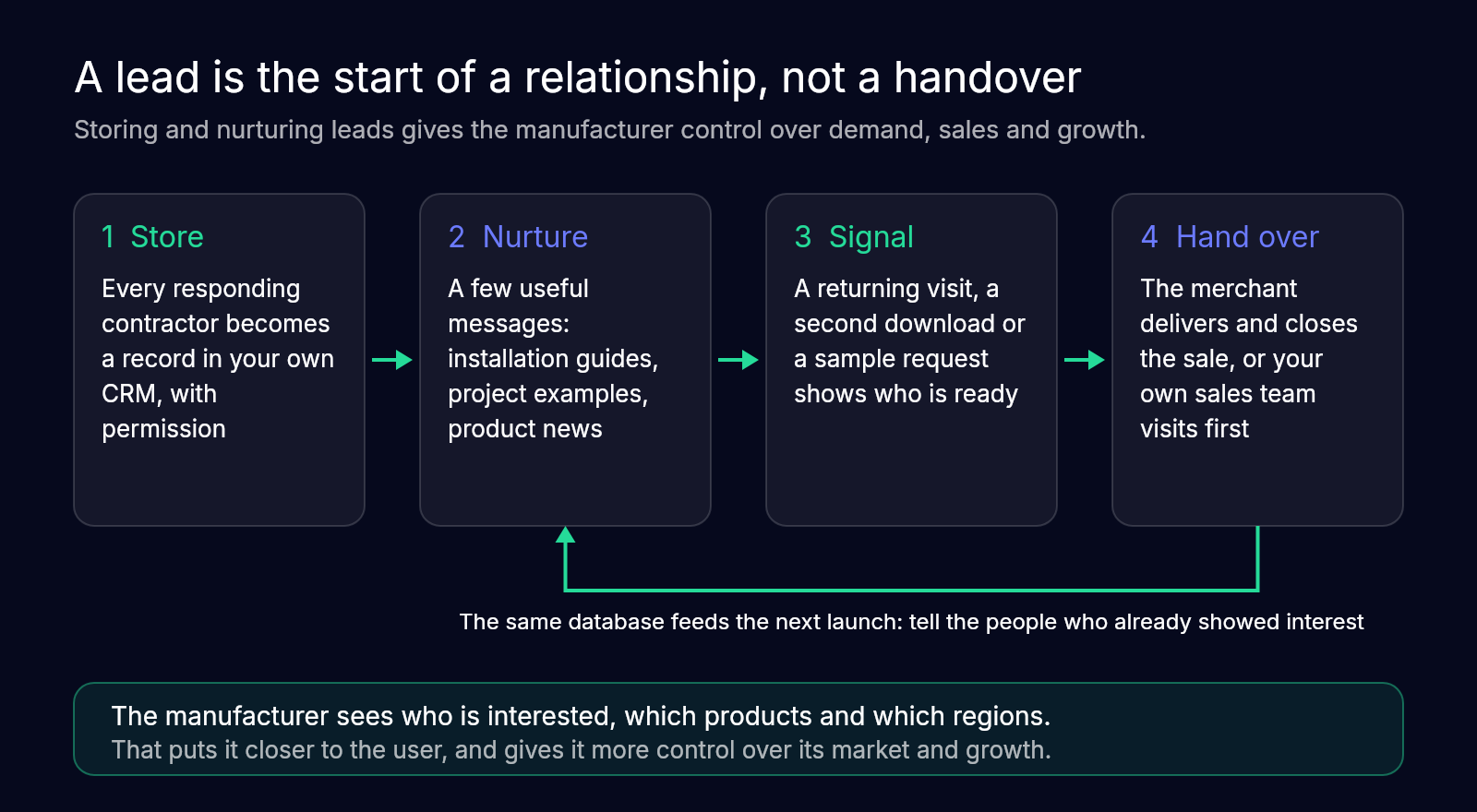
The same database supports the rest of your range. A contractor who uses one product is a natural audience for the next, and a launch no longer starts from zero because you can tell the people who have already shown interest. A large part of the potential sits here, more than in the first campaign.
Two cautions. Permission is not optional: check what your legal basis allows and build opt-in into the first form. And agree with the merchant what each side stores, so the lead record is not seen as a way to take the customer.
What to measure
Start with what you control: the number of qualified contractors reached, the cost per qualified lead, the share that is followed up in time, and how many become quotes or visits. Over time, link those leads to merchant orders, and track how many contractors come back after nurturing, to see the effect on sales. Be careful with the last step. Merchants do not always share data, and attribution in a long chain is never exact, so treat the numbers as direction, not proof.
Where to start
- Pick one product and one contractor type. A recent launch with weak uptake is a good candidate.
- Define the lead. Decide who counts as qualified, where it is stored, and who in your team and at the merchant follows up.
- Run a small test. Reach a defined audience for a few weeks, measure the response and learn from it before you scale.
- Agree with the merchant. Explain that you are adding demand to their channel, not replacing it, and agree what each side stores.
- Give it an owner. This work sits between marketing, sales and the merchant, which is why it often falls between them. Make it explicit for your CEO, CCO, CRO or CMO who owns it.
The principle behind all five steps is the same: do not replace the channel, feed it.