Why Busy Food Companies Lose €2.7M a Year
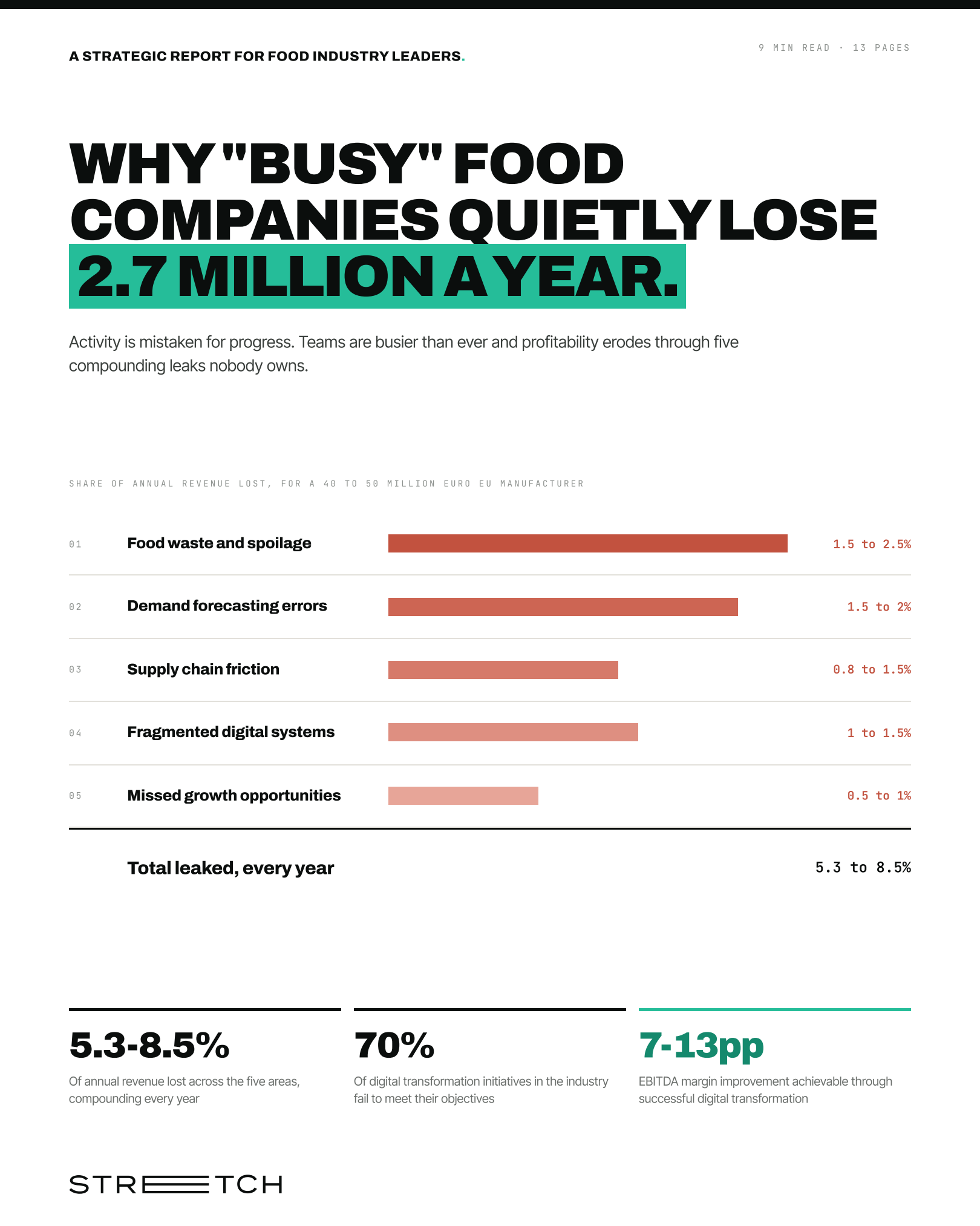
Activity isn't progress. Mid-sized food manufacturers quietly lose 5.3–8.5% of annual revenue through five compounding leaks and most leadership teams don't own a single one.

For most food leaders, the challenge isn't a lack of effort — it's a lack of integrated growth infrastructure. While teams are busier than ever, margin erodes silently through five compounding leaks that nobody owns.
The Five Leaks Draining Your Margin
Research-backed ranges show where the money goes for a €40–50M EU food manufacturer:
- Food waste & spoilage — 1.5 to 2.5% of revenue
- Demand forecasting errors — 1.5 to 2% (median forecast error in food & beverage sits at ~25%)
- Supply chain friction — 0.8 to 1.5%
- Fragmented digital systems — 1 to 1.5%
- Missed growth opportunities — 0.5 to 1%
Combined, that's 5.3 to 8.5% of annual revenue — roughly €2.7M — lost every year, compounding.
Why Food Has Fallen Behind
Food manufacturers have historically prioritised physical assets — machinery, logistics — over data infrastructure. That digital debt is now being called in. McKinsey puts the prize for doing it well at 7–13 percentage points of EBITDA improvement, but 70% of digital transformation initiatives in the industry fail to meet their objectives. Waiting doesn't hold the status quo; it compounds the loss.
Growth Engine vs. Traditional Marketing
A Growth Engine is not a campaign. It is an always-on, data-driven operating system that connects sales, marketing and operations on a single data spine — turning spoilage into R&D budget, guesswork into precision forecasting, and one-off sales into lifetime value. Food's thin 4–6% EBITDA margins mean every optimised percentage point compounds into millions.
Is Your Bucket Leaking?
The guide includes a 10-point self-diagnostic — one point per yes — that maps directly to each of the five leaks. Scores 0–3 mean all five are open. Scores 4–7 mean some are plugged, but the rest are quietly compounding.
Download the full 13-page report to size the leaks against your own revenue, benchmark your operation, and get the roadmap before your next board meeting.