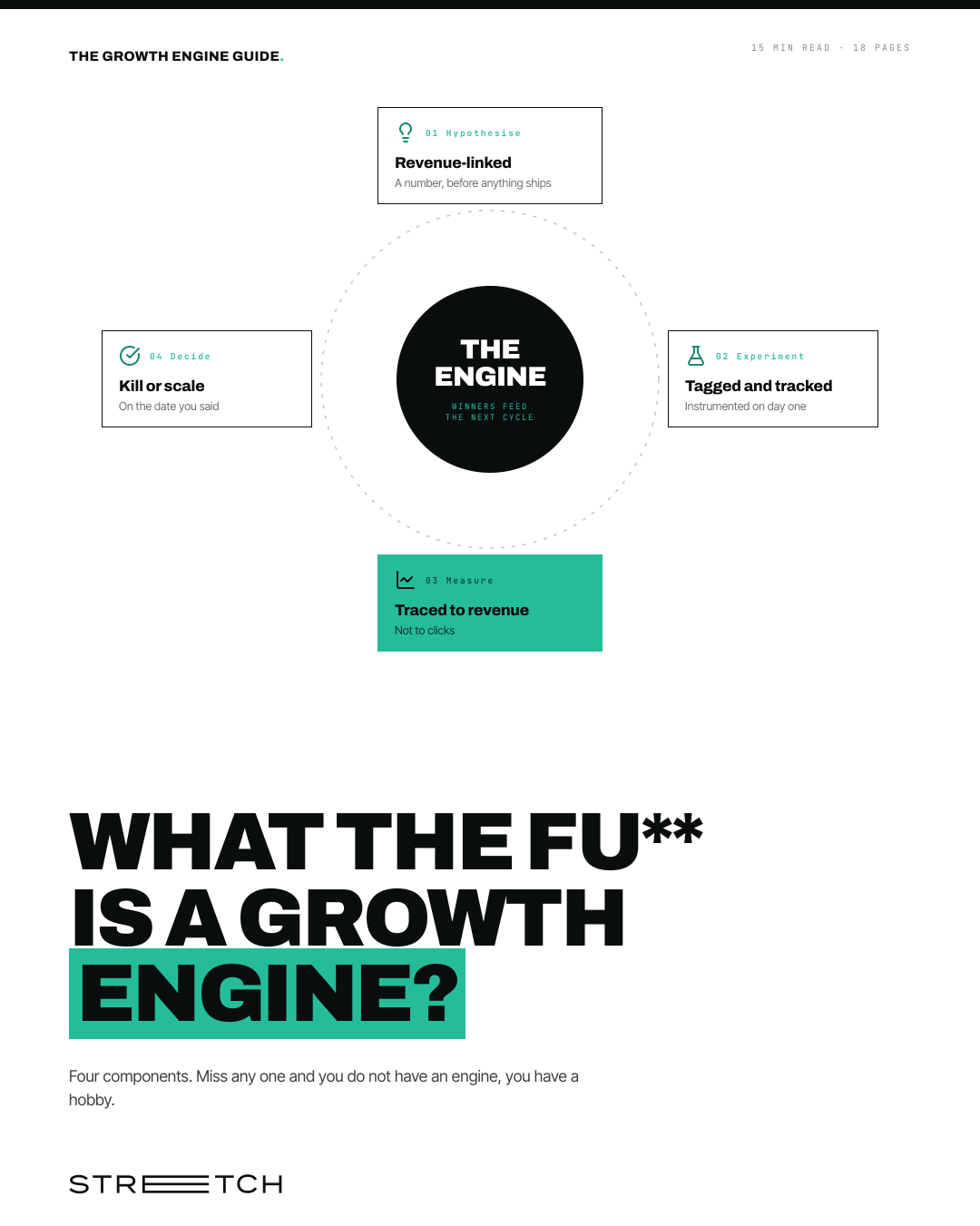
The Growth Engine Guide
Most companies aren't growing they're just doing marketing. This 18-page guide shows you how to build a repeatable Growth Engine that ties every activity to revenue.

Most companies aren't growing — they're just busy. Ads run, content ships, campaigns launch, and numbers move. But when someone asks which of those activities actually produced revenue, the room goes quiet.
The Activity Trap & Attribution Void
If your team can report what they did last quarter but not what worked, you're in the activity trap. Without a tracing layer connecting spend to closed deals, you're not running a growth function — you're running a cost centre that occasionally correlates with revenue.
So What Is a Growth Engine?
A Growth Engine is a repeatable system where every activity is run as an experiment, tied to a revenue hypothesis, traced from first touch to closed deal, and either killed or scaled based on data. Four components — hypothesise, experiment, measure, decide. Miss any one and you have a hobby, not an engine.
The 10-Question Diagnostic
Can you name your top 3 experiments from last quarter and the revenue each produced? Can you trace 80% of closed deals back to an origin experiment? Do you actually kill underperforming experiments within 30–60 days? Most companies score 2–4 out of 10. That's normal. It's also why the blueprint exists.
The Five-Layer Blueprint
Built in order — no skipping:
- Layer 1: Unit economics & true CAC by segment
- Layer 2: A scored, prioritised hypothesis pipeline
- Layer 3: Instrumented execution with upfront kill conditions
- Layer 4: UTM discipline and CRM attribution (aim for 80%)
- Layer 5: A weekly/monthly decision loop with a named decider
One anonymised B2B SaaS company (€180K/quarter spend) used this system to kill 4 failing experiments, save €60K per quarter, and deliver 3× pipeline — in 90 days, with the same headcount.
Download the full guide for the complete diagnostic, blueprint, and a real-world case study with numbers.