How food manufacturers can grow when wholesalers own the customer relationship
Food manufacturers that sell through wholesalers rarely see who buys what. How to segment, score, cross-sell and find white spots anyway, starting from the data you can get.

Many food manufacturers sell most of their volume through wholesalers. The wholesaler knows which bakery, restaurant or hotel orders what. The manufacturer often gets partial sell-out data, weeks after the purchase.
The result is familiar. Cross-sell only happens when a sales rep happens to think of it, the growth potential per customer stays invisible, and marketing is reactive. You do not need a complete picture to change that. You need a few well-chosen steps, in the right order.
Short answer: A food manufacturer that sells through wholesalers can still grow from the data it controls. Start with contacts who gave permission, segment them on type of business and potential, score fit and engagement, trigger cross-sell flows on behaviour, and use outside data to find white spots. Pick one use case and learn from it.
Start with the data you can actually use
In most companies, marketing contacts, permission to mail and purchase data are three different lists. The group that sits in the CRM, has given permission and can be matched to purchases is often a small share of the database. That group caps how many people any flow can reach.
Check this before you build anything. A flow for a handful of contacts is a nice demo, not a growth program. Raising permission is therefore often the first real priority. Options include a one-off message to existing contacts that explains what they get by staying on the list (check what your legal basis allows), sign-ups through a loyalty or scan-based program where customers register purchases, and ads that promote your newsletter to build an audience.
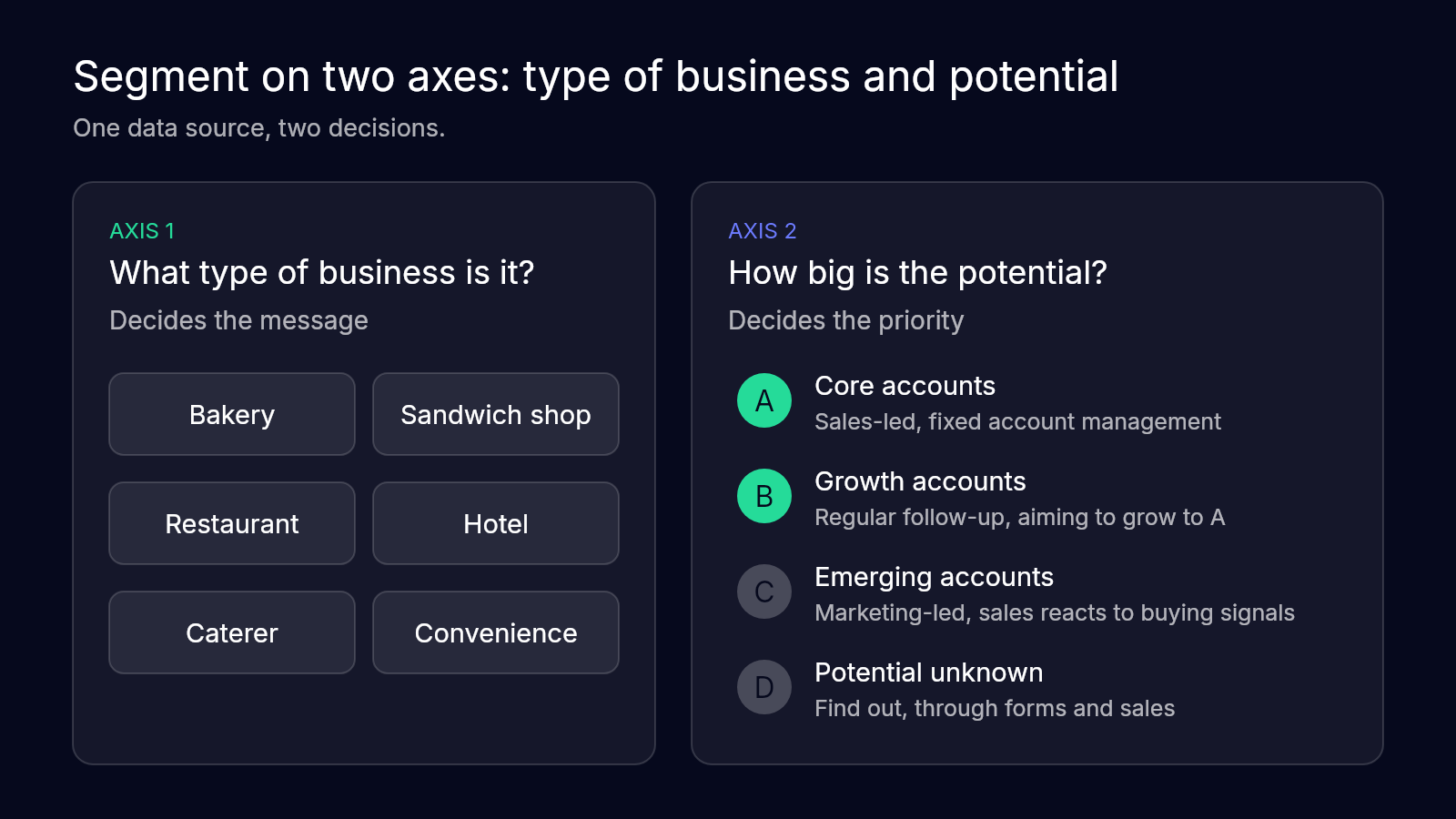
On top of that foundation, three layers follow, each answering one question about a customer.
Layer 1: segment on two axes
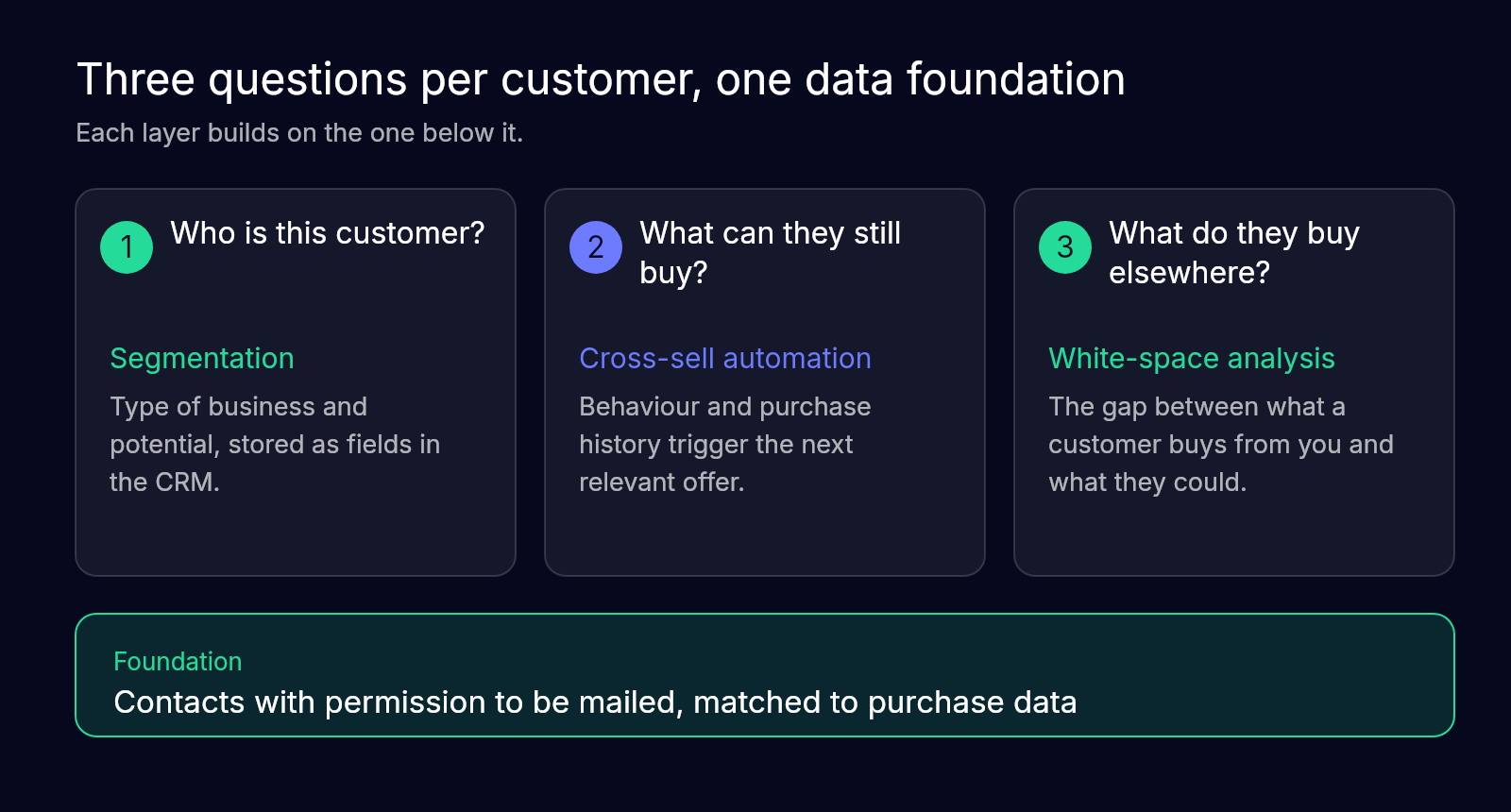
Segmentation answers two questions. What type of business is this? That decides the message, because a bakery, a sandwich shop and a hotel have different needs and should hear different things. And how big is the potential? That decides the priority, so that marketing and sales effort goes where it matters most.
You do not need exact consumption to size potential. A good proxy per subchannel is enough: for a bakery the number of outlets and baking capacity, for a hotel the rooms and occupancy, for a restaurant the seats and the menu. Store both answers as fields on the company record in the CRM. Every list, workflow and report can then hang on those fields instead of on manual lists.
Grouping potential into classes, for example A to D, gives sales and marketing one shared language. Top accounts get sales-led account management. Smaller ones are worked by marketing, and sales steps in when a buying signal appears. Costly actions can follow the class: a sample box that costs real money only for the top classes, a promotion that customers partly pay for, for everyone.
If potential comes from several sources, decide their order up front. For example: confirmed by sales first, then the external data source, and only then the customer’s own answer in a form.
Fill the gaps with progressive profiling
Long forms lose people. Progressive profiling solves this. In HubSpot it is called progressive fields: you queue fields in priority order, and a contact who already has a value for one sees the next field instead. The form stays at four or five questions, but you learn something new at every touchpoint. At the time of writing this is available on the Professional and Enterprise plans, in the form editor that supports it, so check your setup first.
Ask the minimum first: company, name and segment. Ask more when intent is high, such as for a promotion or a sample. Keep a few basics visible every time, so a form never feels like it knows too much. Pre-filled forms also help, because they remove typing errors.
If you have many legacy forms, do not rebuild them all. Work from a template, and move the high-volume forms over first.
Layer 2: score fit and engagement, and add a step before field sales
Lead scoring in HubSpot has two parts. Fit scores who they are: type of business, potential, role of the person, priority segments or regions. Engagement scores what they do: product page visits, email clicks, event attendance. Leads should reach sales only with buying intent, such as a direct request, taking up a promotion, or crossing a threshold. Compare that threshold with the engagement of your existing customers rather than guessing.
Scores also need to age. A click from two years ago is not a warm lead. HubSpot supports score decay: for each scored event you can reduce its points by a percentage after a set period. Events that only happen once a year can fade slowly, email engagement faster.
A second problem is that field sales are used to buying conversations, and low-intent marketing leads discourage them. We have set up an extra step at several companies: inside sales. This person calls first, and it is not a sales call. It is a conversation about, for example, whether the guide they downloaded was what they were looking for. They decide who goes to field sales, and they tell marketing whether the scoring is right. You can start with a freelancer or an external partner before hiring. Check your consent rules for calling first.
Layer 3: cross-sell flows that start from behaviour
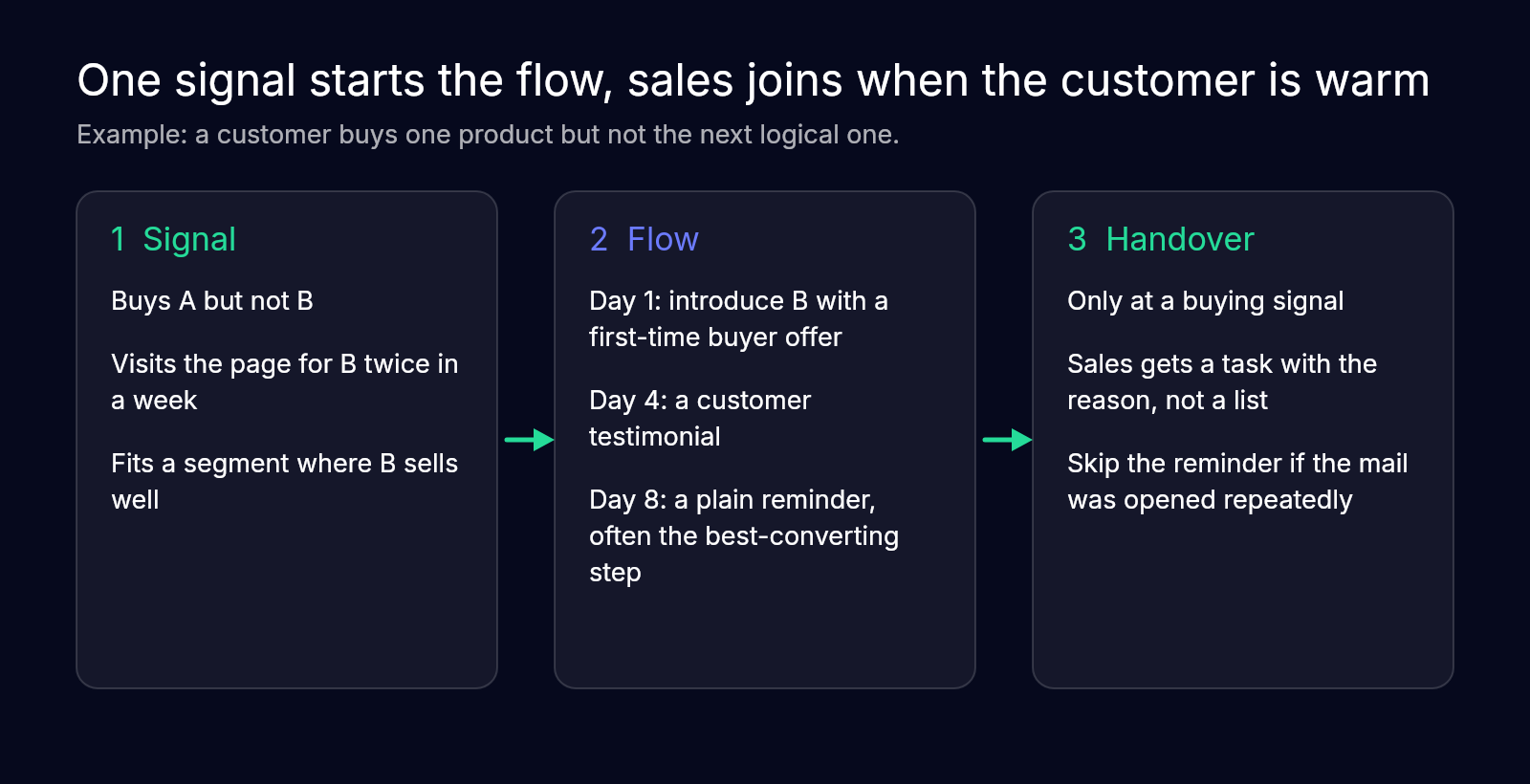
Cross-sell does not need to wait until a sales rep thinks of it. A customer who buys one product and then visits the page for another, or downloads a brochure for it, is giving a signal. Set a score threshold per product, and let crossing it start a flow.
A flow of three emails works well: introduce the product with an offer to try it, follow with a customer testimonial, and end with a plain reminder. In our experience the reminder often converts best. Skip it for people who have already opened the mail several times. Sales only joins when a buying signal appears, with a task that states the reason.
Make the offer a first-time buyer test, not a free handout, so it does not attract people who just take what is free. If a sample box is too expensive, a one-plus-one offer does the same job. Tell your wholesalers about it in advance, otherwise they feel you are giving discounts behind their backs. Season and moment, and the right format per channel, give you more triggers than purchase history alone.
Layer 4: find the white spots
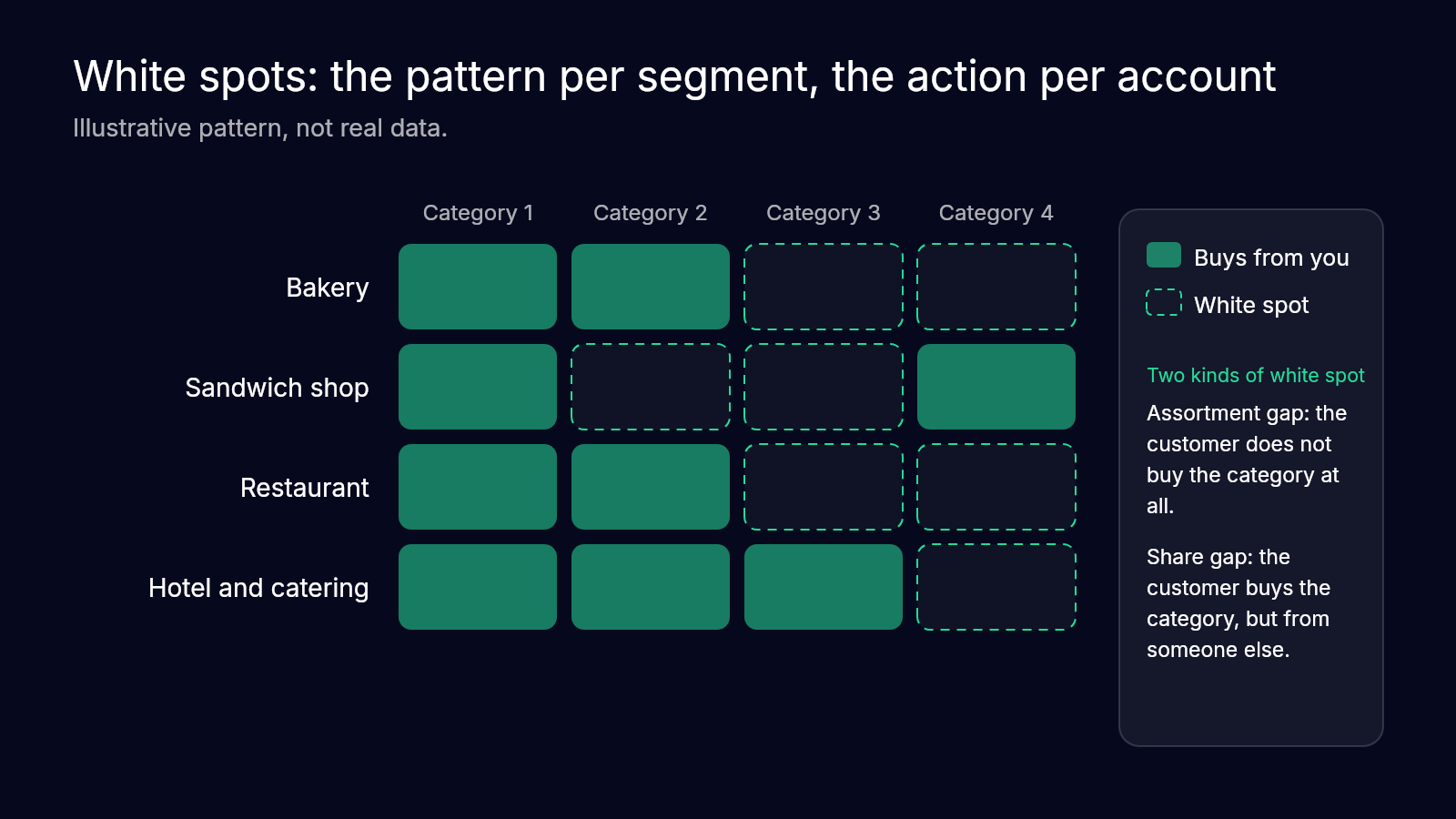
Cross-sell works on what you know. White-space analysis shows what you do not know. There are two kinds: an assortment gap, where a customer does not buy a category at all, and a share gap, where they buy it from someone else.
Your own order and sell-out data covers part of this. The rest you can fill from public information: menus, websites, opening hours and capacity, read with a scraping tool and an AI analysis to infer which products would fit an outlet. Field data adds what you cannot see online.
Scan data from a loyalty program can add two things. Churn becomes clear when customers stop scanning, which lets you build prevention flows. And products that are often bought together point to bundles you can offer. Be careful with definitions in sell-out data, though: someone who switches from one product to a similar one has not churned.
How to pick the first use case
Score your ideas on impact, reach and ease. Reach matters most here: do not prioritise something that only touches a few contacts. Ease depends on how many third parties, new tools and data you need. A manual data pull is fine to start with, and an integration can come later.
Where to start
This week, list five obvious use cases. For each one, count how many contacts you can really reach, given permission and matching. Choose the one with the best combination of impact, reach and ease, run it for a few weeks, and learn from it. The potential classes, the segment fields and the permission base you build on the way are reused by every next use case.
Sources